
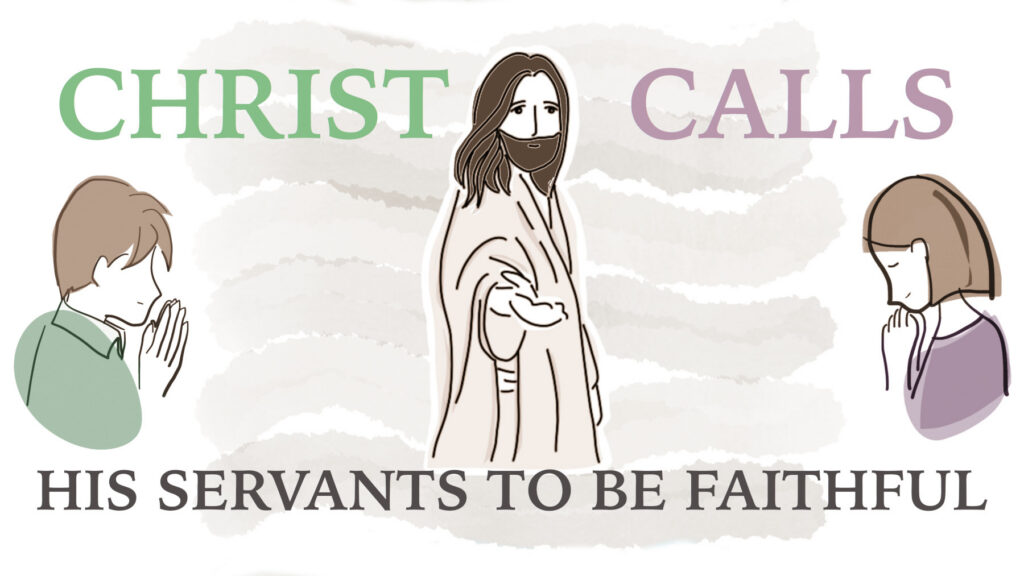
1 Corinthians 4:1-7 ● June 14, 2026 ● Series: Christ Calls His Servants to be Faithful● Print Version ● Listen to Sermon audio
A lighthearted group called “Bearded Gospel Men” shares photos on social media urging Christian men to grow a beard. In one photo there are two men compared side-by-side. One has a beard and stern look, the other has a clean-shaven face and inviting smile. Both appear to be preachers. The caption under the bearded one reads, “this” and the other side with the non-bearded man reads “not that.” One man is supposed to be preferred over the other. Can you guess why? It’s not over the smile on the guy to the right. It’s not over the stern look on the guy at the left. It’s just that one is clean shaven, while the other is clearly sporting a mature beard. It’s the small things which heavily influence how we rate or evaluate people. You haven’t even heard a word from either of these men. “Bearded Gospel Men” would like you to prefer the one with the beard. It’s just facial hair and hair style. It’s fashion, that’s all. But psychologist point out how quick we are to form our opinions of others. The brain quickly forms initial judgments about trustworthiness and competence, and it can do it in a fraction of a second based entirely on someone’s facial features or mannerisms.
We can’t say if it was just fashion, but superficial opinions were dividing the church in ancient Corinth. The apostle Paul wrote the first several paragraphs of his letter about such divisions. Paul points out how human wisdom makes no difference when it comes to preachers of the gospel. The power is in the gospel. He argues that no one should care if he didn’t come with persuasive speaking ability. He came with the Spirit and shared spiritual truths. Nonetheless, divisions were sprouting up among the Christians in Corinth! Over what?! Not doctrinal errors but over “who follows who.”
Different factions were saying, “I follow Paul,” “I follow Apollos,” or “I follow Peter.” And still others sought to elevate themselves over the rest, “I follow Christ,” they asserted. Apparently, they rejected all the pastors. The synagogue in Corinth had rejected the Christians. So, they met at a house church. Imagine walking into the house of Titius Justus in Corinth where Paul often had meet with them during his 18 months in the city. Imagine you show up and see a little circle of friends talking. It’s the Apollos crew. They love how Apollos could vigorously refute the Jews in public debate. He’s the man! They’d follow Apollos anywhere. In another corner you’d have seen some of the Peter fan club. Always talking about how Peter is the real apostle to follow. “Peter had been a disciple of Jesus. Did you get to read Peter’s latest blog post sent to the churches?” Then there was the OG Corinthian church. Paul was one of the first to come to Corinth and publicly proclaim the gospel. He had first brought them to faith. “Who was it again that had been actually baptized by Paul? Lucky ducks!” And besides, have you ever met a hard-working tent maker you didn’t like?
Paul heard reports about these cliques and these claims. He had already shared the mysteries of God with them. But he still had something more he needed to share. He needed to help them rightly understand the answer to an important question: What makes for a proper preacher? Who did they belong to? Would Paul’s letter help them settle the matter?
He begins by first pointing out that these leaders were merely men who have different roles and gifts as leaders in the church. “What, after all, is Apollos? And what is Paul? Only servants, through whom you came to believe—as the Lord has assigned to each his task. 6 I planted the seed, Apollos watered it, but God made it grow. 7 So neither he who plants nor he who waters is anything, but only God, who makes things grow.” (3:5-7)
They are only servants, but no ordinary servants. “So then, men ought to regard us as servants of Christ and as those entrusted with the secret things of God.” Paul is including his fellow workers, Peter, Apollos. He really speaks regarding all spiritual leaders. When the Corinthian Christians dismissed a faithful pastor, they sinned. They dismissed “servants of Christ” who had a vital role, “entrusted with the secret things of God.” Literally it reads more like “those who are house managers of the mysteries of God.” These titles carry a double importance.
First of all, spiritual overseers are servants and house managers. They don’t do as they please. They don’t decide their own teachings. The pastor can only do what he is called by Christ to do. A servant doesn’t invent new doctrines or toss out the old. A house manager doesn’t own the house and do remodeling projects. He serves by doing what he has been instructed to do by the master. In this case the master is Christ.
That brings us to the second part. While the pastor is only a servant and house-manger, he is still in a position that should be honored and respected. He serves Christ. He has been entrusted by Christ to handle his Word. The phrase “secret things of God” refers to the hidden will of God or things we cannot know about God, things which we wouldn’t ever know unless God revealed them to us in his Word. Paul uses this phrase to refer to the gospel.
This whole first sentence gives me pause. Not because I haven’t regarded Paul as a servant of Christ and viewed him in this light. But have I always viewed the pastors in my life with the same high regard? Sure, I am now a pastor, but in the course of my Christian training and my moving about I’ve lived in nine different towns, moved ten different times, and regularly attended even more churches during all that time. In addition, I’ve had more pastors serving over me as instructor than I have fingers and toes. Have I always regarded them as servants? Or did I sometimes get carried away by their charisma and praise one pastor, one professor, over another? And did I always view them as servants of Christ and give them the proper regard? In all the churches I’ve attended do you think I was ever tempted to say “that was an awesome sermon” with undo focus on the person? Did my wife and I ever hear a Bible study delivered like it was a dry piece of toast which the presenter made us choke on? Did we ever hear any sermons that we had to struggle with all our might to just appear like we were still awake? The servant is nothing yet is entrusted by Christ with the gospel. “So then, men ought to regard us as servants of Christ and those entrusted with the secret things of God.” Wow. Guilty. “I didn’t like his comb-over.” “Why didn’t he smile more?” “His handshake is too sweaty.” “All I remember him talking about was beards.” These are shallow critiques and a failure to regard Christ’s servants.
Now, don’t get me wrong. Paul isn’t saying that a pastor is entirely above evaluation. He isn’t saying that ministers have a free pass to be like Eli’s wicked sons and get away with all sorts of laziness or evil. Paul welcomed scrutiny and even urged the Christian congregations he visited to judge those who share God’s Word. A pastor ought to be the most scrutinized person you meet each week, leading by example.
But on what basis ought a pastor be criticized and evaluated? “Now it is required that those who have been given a trust must prove faithful.” If Paul is to be investigated or evaluated by anyone, or any minister of the gospel is to be evaluated, this is the fundamental criteria: that they are faithful. If a pastor is entrusted with the things of God, what does it mean to be faithful? Does he faithfully do what he has been called by God to do: share the truth of God’s Word and live according to that truth as an example for the flock.
Is this the criteria we always stick to? It is easy for a preacher to be praised as popular, interesting, intelligent, witty, charismatic, strong, influential, creative, and fashionable. But all these things are not criteria which one ought to use to compare and rate ministers. Last I checked no pastor was ever called to be a comedian, a fashion guru, or an administrative genius. Those things aren’t wrong. Some men are more gifted in these areas or others. Shouldn’t a pastor care about some of these things? Certainly, he can seek to improve in areas where it helps. But these are not criteria by which you ought to judge a minister.
Why not? Judging ministers only by human standards leads to many problems. Paul says he won’t hold himself to any human standard of judgment. To do so is destructive to the church. It causes great damage to the ministry of the gospel and undermines the one who entrusted as house manager in God’s house. Paul goes on, “I care very little if I am judged by you or by any human court; indeed, I do not even judge myself. He isn’t saying it is wrong to hold a pastor accountable to God’s Word. He is saying the minister shouldn’t be judged according to human standards. Nor should he hold himself to human judgment. God’s standards matter.
What happens when a servant in the church judges and evaluates themselves by human standards? 1) They get puffed up and prideful. 2) They sink into a pit of despair over all their shortcomings. And don’t think that a pastor doesn’t swing back and forth between these two things! He too sinks into the trap of judging according to human standards! “I can’t do administration like so and so, I can’t be dynamic and interesting like so and so, I’m not as charming as so and so, I’m not as fashionable as so and so.” I was talking to another pastor early in my ministry. He had a real concern if he ought to shave his beard because one of his members said it was not fitting for a pastor to have a beard. (Don’t tell him about the custom at the time of Jesus in ancient Israel.) Corinth was divided over human opinions! Does this ever divide us?
To be a servant of Christ is to be unafraid to offend this world and speak for Christ alone. This is what a servant of Christ does. He doesn’t seek to put himself first, he seeks to put Christ above all else. He doesn’t want people to see him; he wants them to see Christ in spite of his shortcomings.
That takes humility by all Christians and pastors. Humility comes from knowing all we have is a gift from Christ. We are saved by grace and serve him in grace. “For who makes you different from anyone else? What do you have that you did not receive? And if you did receive it, why do you boast as though you did not?”
Christ came scorning the opinions of those who rejected him. They despised him. But he cared only that he faithfully carries out the Father’s will. Though he was worthy of the highest honor he lowered himself. He wasn’t a servant. But he made himself nothing and took on the very nature of a servant. Being found in human flesh he committed himself to one cause: faithfully carrying out the Father’s will on our behalf. He committed himself to faithfully preaching and teaching the truth. He committed himself for us to faithfully going to the cross. He faithfully gave his life for us all. It doesn’t matter whether he had a short or long beard. It doesn’t matter whether he wore the latest sandals by the Gideon sandal shop. It doesn’t even matter if he ended up smelling like the fishermen he hung out with or the expensive perfume he was anointed with. All that really mattered was he faithfully served us all, and in doing so brought life to us all. He carried out the mysteries of God as he atoned for sin and rose again in victory over the grave.
Paul’s letter certainly helped them settle the matter of who to follow. They were to follow faithful servants of Christ and in doing so they followed Christ. They were to forget about all the other human opinions which divided them. When Christ returns, he will expose the hypocrisy of any pastor or missionary. He will make the judgment, and it will be a right one. And thank God he will forgive all the times I’ve wrongly put one minister over another. He forgives all the times I judged myself according to human standard instead of according to faithfulness to his Word. And by his grace he will heal the things which might divide any Christian church. And he will use his faithful servants to do it as they share his good news of forgiveness in Christ. And he might even use a pastor without a beard to do it. Amen.
Podcast: Play in new window | Download
Subscribe: Apple Podcasts | Spotify | Pandora | RSS